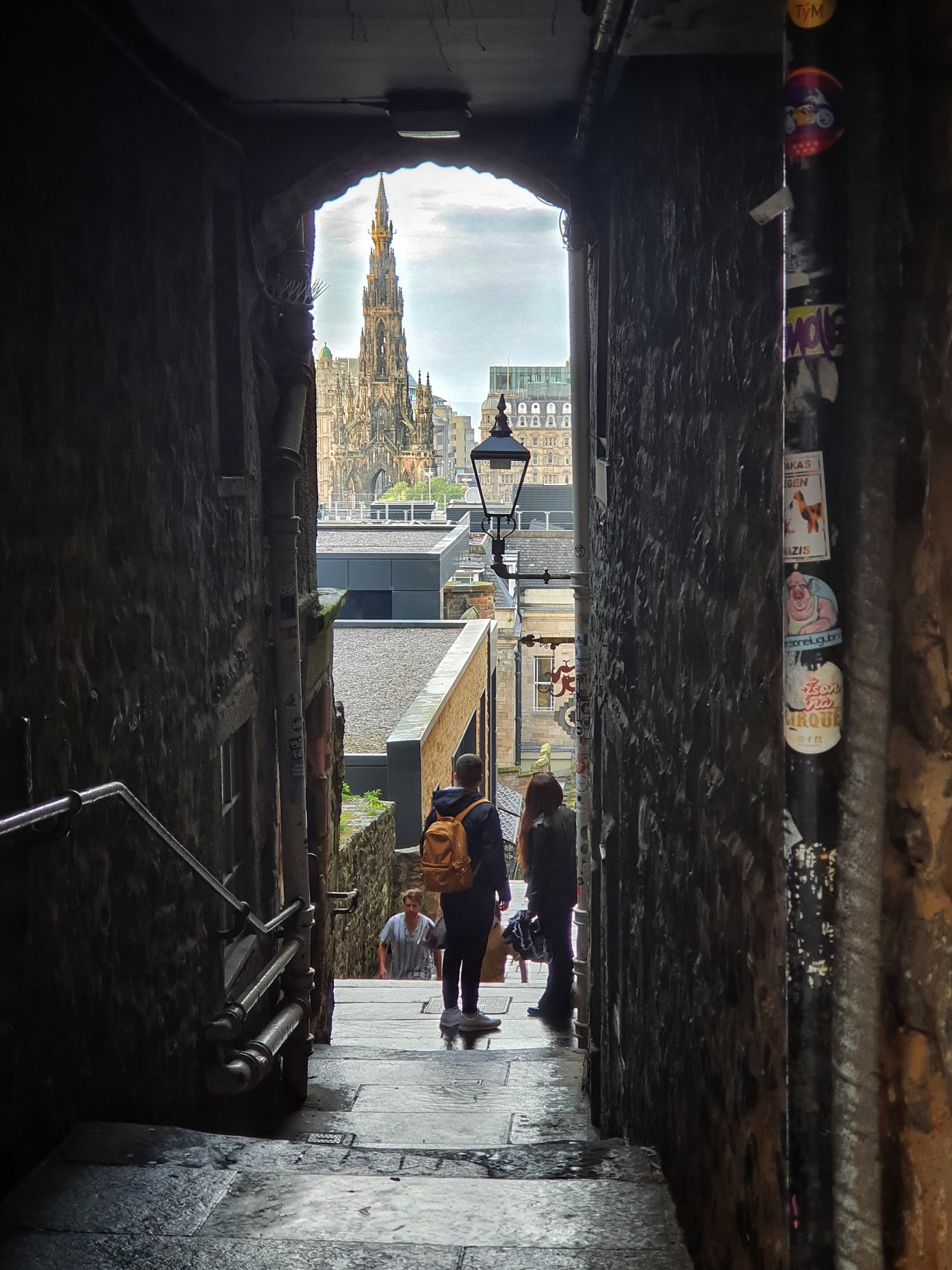
Hidden Gems and Curiosities: 13 Lesser-Known Places That Reveal Edinburgh's Secret Side
Edinburgh is a city that rewards the curious. Most visitors stick to the well-trodden path -- Castle, Royal Mile, Arthur's Seat, a whisky tour if they're feeling adventurous -- and there's nothing wrong with that. But peel back the obvious layer and you'll find a city riddled with secret gardens tucked behind medieval walls, hand-carved underground chambers no one can fully explain, Cold War bunkers buried beneath golf courses, and a bronze statue of a bear who held the rank of Private in the Polish Army.
This is the Edinburgh the guidebooks tend to skip. Here are thirteen places that will change how you see the city.
Underground Edinburgh: What Lies Beneath
Edinburgh is famously built on layers. The Old Town sits on a volcanic ridge, and over the centuries, entire streets and vaults have been swallowed by later construction. But the subterranean stories extend well beyond the tourist-friendly Real Mary King's Close.
Gilmerton Cove
Beneath the quiet suburb of Gilmerton, about five miles south of the city centre, lies one of Edinburgh's genuinely unexplained mysteries. Gilmerton Cove is a series of hand-carved underground chambers and passageways hewn directly from the sandstone bedrock. Nobody knows for certain who made them, or why.
The conventional story attributes the cove to a local blacksmith named George Paterson, who supposedly carved the space in the early 1700s and used it as a drinking den. But the scale and sophistication of the work has led historians to propose more colourful theories: that it was a hideout for persecuted Covenanters during the religious wars of the 17th century, a smugglers' lair connected to a network of tunnels, or -- inevitably -- something to do with the Knights Templar.
What you'll actually find is a series of low-ceilinged rooms with carved stone tables and benches, connected by narrow passages. It's atmospheric and genuinely strange. Tours must be pre-booked, and they fill up quickly in summer, so plan ahead. The cove is at 16 Drum Street, EH17 8QH.
Barnton Bunker
Fast forward a few centuries from Gilmerton's medieval mystery to the Cold War paranoia of the 1950s, and you'll find another remarkable underground space -- this time buried 100 feet beneath Corstorphine Hill on the western edge of the city.
Barnton Bunker was Scotland's secret nuclear command centre, designed to house military and government officials in the event of a Soviet nuclear strike. It's a sprawling, multi-level facility with blast doors, decontamination chambers, communication rooms, and dormitories -- all preserved in a state of eerie Cold War readiness.
The bunker was decommissioned and largely forgotten for decades before being opened for guided tours. Walking through its corridors, with their institutional paint and vintage telecommunications equipment, is a powerfully unsettling experience. It's a concrete reminder that Edinburgh was once a target. Guided tours run at around 25 pounds and last roughly ninety minutes. Wear warm layers -- it's chilly down there year-round.
Innocent Railway Tunnel
Not all of Edinburgh's tunnels require a ticket. The Innocent Railway Tunnel beneath the southern slopes of Arthur's Seat is 518 metres of atmospheric Victorian engineering that you can walk or cycle through any time you like.
Built in 1831, it's one of Scotland's oldest railway tunnels, originally part of the Edinburgh and Dalkeith Railway. The line earned its nickname "the Innocent Railway" because the early carriages were horse-drawn rather than steam-powered, making it -- in theory -- less likely to kill anyone. The tunnel is now part of a popular walking and cycling path connecting Holyrood Park to the southern suburbs. It's unlit, so bring a torch if you want to appreciate the rough-hewn stonework, and be prepared for the odd puddle underfoot.
Secret Gardens: Green Sanctuaries Hidden in Plain Sight
Edinburgh has no shortage of parks, but some of its most beautiful green spaces are genuinely hidden -- tucked behind walls, down narrow closes, or in locations so improbable that even long-time residents haven't found them.
Dunbar's Close Garden
If you've walked the Royal Mile more than once, you've almost certainly walked past this without knowing it existed. Dunbar's Close Garden is a small, exquisitely designed 17th-century-style walled garden reached through a narrow close at 137 Canongate, EH8 8BW.
Push through the entrance and you step from the bustle of the Canongate into something that feels lifted from another century: clipped hedges, gravel paths, stone benches, and a layout modelled on the formal gardens that would have existed behind Edinburgh's grand townhouses in the 1600s. It was actually created in the 1970s by the Mushroom Trust, but the historical authenticity is convincing.
It's free, open from dawn to dusk, and almost always quiet. On a summer afternoon, with the noise of the Royal Mile reduced to a murmur, it's one of the most peaceful spots in Edinburgh's Old Town.
Dr Neil's Garden
If Dunbar's Close feels like a step back in time, Dr Neil's Garden feels like a step out of the city entirely. Tucked on the shore of Duddingston Loch, right at the foot of Arthur's Seat, this landscaped garden is so improbably rural that first-time visitors often can't believe they're still within Edinburgh's city limits.
Created over decades by doctors Andrew and Nancy Neil, it's a labour of love: winding paths through alpine plants, mature trees, and rocky outcrops, all sloping down to the loch where swans drift past and herons stand in the shallows. The garden is at 5 Old Church Lane, EH15 3PX, next to the beautiful Duddingston Kirk. It's free to visit, though donations are welcome and richly deserved.
Edinburgh-Kyoto Friendship Garden
Edinburgh and Kyoto have been twin cities since 1994, and the most tangible expression of that friendship is a one-hectare Japanese garden in the grounds of Lauriston Castle, on the city's northwestern fringe near Cramond.
Designed by the renowned Japanese landscape architect Takashi Sawano and opened in 2002, it's a place of considered calm: raked gravel, carefully placed stones, clipped pines, and a traditional tea house. The garden follows authentic Japanese design principles, and on a still day, with the Firth of Forth visible through the trees, the fusion of Scottish and Japanese landscapes is quietly remarkable.
The garden is free to visit but keeps limited hours, particularly outside summer. It's at Lauriston Castle, 2A Cramond Road South, EH4 5QD. Check opening times before making the trip.
Art in Unexpected Places
Edinburgh's galleries are world-class, but some of the city's most striking art isn't hanging in the Scottish National Gallery. It's painted inside a disused railway tunnel, standing waist-deep in a river, or covering every surface of a converted church.
Colinton Tunnel Mural
The Colinton Tunnel is a 140-metre disused Victorian railway tunnel on the Water of Leith Walkway, and it's home to Scotland's largest heritage mural. The tunnel was part of the old Balerno branch line, closed in 1943, and for decades it was a dark, dripping passageway that walkers hurried through.
Then, starting in 2019, a team of volunteer artists transformed it into something extraordinary. The mural tells the story of the local area's heritage: Robert Louis Stevenson, who spent childhood summers at his grandfather's manse in nearby Colinton village, features prominently, alongside scenes of the area's paper mills, wildlife, and railway history. The artwork wraps around the curved tunnel walls, creating an immersive, cathedral-like effect.
It's free, accessible 24 hours a day (though you'll want daylight or a torch), and it's become one of the most photographed spots on the entire Water of Leith path.
Antony Gormley's "6 TIMES"
Stay on the Water of Leith and you might stumble across something startling: a life-size, rust-coloured cast iron figure standing motionless in the water.
Antony Gormley -- the artist behind the Angel of the North -- installed six of these sculptures along a stretch of the Water of Leith in 2010, as part of a collaboration with the Scottish National Gallery of Modern Art. The figures are placed at various points between the gallery and Leith, some visible from the path, others half-hidden by vegetation or partly submerged.
Part of the pleasure is the hunt. The sculptures aren't signposted or mapped (though locals will often point you in the right direction), and encountering one unexpectedly -- a silent iron figure standing in the current, staring downstream -- is genuinely arresting. They're free to find, assuming you can.
Mansfield Traquair
Often called "Edinburgh's Sistine Chapel," Mansfield Traquair at 15 Mansfield Place, EH3 6BB, is a former Catholic Apostolic Church whose interior is covered floor-to-ceiling in spectacular murals painted by the Irish-born artist Phoebe Anna Traquair between 1893 and 1901.
Traquair was one of the most significant figures in the Arts and Crafts movement in Scotland, and this is her masterwork: vast, luminous panels depicting scenes from the Old and New Testaments, the figures rendered with a Pre-Raphaelite richness that glows in the natural light from the church's high windows.
The building is now an events venue, which means public access is limited to occasional open days and heritage weekends. When it is open, the experience of standing beneath those murals is genuinely breathtaking. Check the website for upcoming open days -- it's worth planning around.
Jupiter Artland
A short drive west of Edinburgh, in the grounds of a Jacobean manor house near Wilkieston, Jupiter Artland is a 100-acre sculpture park that ranks among the finest in Europe.
The collection includes major works by Anish Kapoor (a vast red void set into a hillside), Antony Gormley (a crouching figure inside a purpose-built chamber), Andy Goldsworthy (stone walls that snake through woodland), and Charles Jencks (enormous landform sculptures that reshape the terrain itself). There are over 35 permanent works scattered across woodland, meadow, and formal gardens, and the park hosts a changing programme of temporary exhibitions.
Jupiter Artland is at Bonnington House Steadings, EH27 8BY. It's seasonal (typically May to September), and admission is charged. Allow at least half a day -- the grounds are extensive, and rushing through would miss the point entirely.
Curiosities and Monuments: Stories Hiding in Plain Sight
Some of Edinburgh's most fascinating stories are attached to objects and monuments that most people walk past without a second glance.
Wojtek the Soldier Bear
In the western corner of Princes Street Gardens, near the Ross Bandstand, stands a bronze statue of a bear. Not just any bear. Wojtek was a Syrian brown bear adopted as a cub by soldiers of the Polish II Corps during the Second World War. He travelled with them through Iran, Palestine, Egypt, and Italy, and at the Battle of Monte Cassino in 1944, he helped carry ammunition -- boxes of 25-pound artillery shells -- to the guns.
To solve the logistical problem of having a bear in the army, the soldiers officially enlisted him as a Private, with his own paybook and serial number. After the war, Wojtek and many of the Polish soldiers were resettled in Scotland. The bear spent his retirement at Edinburgh Zoo, where he lived until 1963, occasionally perking up when he heard Polish spoken by visitors.
The statue, unveiled in 2015, shows Wojtek walking alongside a fellow soldier. It's free to visit and easy to miss if you don't know it's there.
St Bernard's Well
St Bernard's Well is one of those Edinburgh landmarks that looks as though it's been transplanted from ancient Rome. Standing on the banks of the Water of Leith in Stockbridge, this elegant neoclassical pump room was built in 1789 and modelled on the Temple of Vesta at Tivoli.
The well was constructed to house a natural mineral spring that had been "discovered" in 1760 (locals had known about it for centuries). The water was believed to have medicinal properties, and for a time St Bernard's Well was a fashionable destination for Edinburgh's health-conscious citizens. Less fashionably, the spring water was later found to contain arsenic, which may have somewhat undermined its therapeutic claims.
The exterior is freely accessible from the Water of Leith Walkway. The interior pump room, with its mosaic floor and statue of Hygieia (goddess of health -- an ironic touch given the arsenic), is occasionally opened for special events.
Cramond Island
At the western edge of Edinburgh, where the River Almond meets the Firth of Forth, a concrete causeway stretches across the mudflats to Cramond Island -- a small, wild, uninhabited island with a fascinating wartime history.
During the Second World War, Cramond Island was part of the Forth's coastal defences. The concrete pylons that line the causeway are the remains of an anti-submarine boom that stretched across the river to prevent German U-boats from reaching the naval base at Rosyth. On the island itself, you can explore the remains of gun emplacements, lookout posts, and military buildings, all slowly being reclaimed by grass and gorse.
The walk to the island takes about fifteen minutes, but there's a critical caveat: the causeway is tidal, and it's submerged for several hours either side of high tide. People get stranded on Cramond Island with depressing regularity. Check the tide times before you set out -- they're posted at the start of the causeway -- and give yourself a generous margin. Getting rescued by the coastguard is not a hidden gem.
Museum on the Mound
Perched on the Mound, halfway between the Old Town and New Town, the Museum on the Mound occupies the headquarters of the Bank of Scotland and is one of Edinburgh's best free museums that almost nobody visits.
The star attraction is a glass case containing one million pounds in banknotes -- a satisfying thing to stand next to, even if you can't take any home. But the museum also tells the broader story of money, trade, and banking in Scotland, with displays on everything from the Darien Scheme (Scotland's disastrous attempt to establish a colonial trading post in Panama) to the mechanics of forgery. It's thoughtfully curated, genuinely interesting, and open Tuesday to Saturday.
Planning Your Exploration
Many of these places connect naturally. The Water of Leith Walkway links the Colinton Tunnel Mural, St Bernard's Well, and Antony Gormley's "6 TIMES" along a single riverside path -- you could see all three in a long morning's walk. Dunbar's Close Garden and the Museum on the Mound are both within easy reach of the Royal Mile. Dr Neil's Garden pairs naturally with a walk up Arthur's Seat or a visit to the Innocent Railway Tunnel.
For the outlying sites -- Gilmerton Cove, Barnton Bunker, Cramond Island, and Jupiter Artland -- you'll want to plan separate trips, ideally with pre-booked tickets where required.
A few practical notes:
- Gilmerton Cove and Barnton Bunker both require advance booking. Don't turn up hoping to walk in.
- Jupiter Artland is seasonal. Check opening dates before making the journey.
- Cramond Island is tidal. Check the tide tables. Really. Check them.
- Mansfield Traquair is only open on limited occasions. Monitor their website for open days.
- The Edinburgh-Kyoto Friendship Garden has restricted hours. Confirm before visiting.
- Most of these places are free or low-cost. Edinburgh's best-kept secrets tend not to charge admission.
The city has always been good at hiding things -- beneath its streets, behind its walls, along its riverbanks. These thirteen places are proof that the most rewarding discoveries in Edinburgh come to those willing to look a little harder.